Where Did All the Advert Jingles Go?
We still remember Nigerian jingles from 20 years ago. We can barely remember the ads we saw yesterday. What changed?
Sometimes, I like to watch old Nigerian commercials when I want to feel something. I don’t always have a particular reason but sometimes I just miss being a child, sitting in front of the television with nowhere to be and nothing to worry about. And with this year’s Independence Day, I found myself in one of those nostalgic moods again.
So, I went looking for old commercials.
There is something about watching them now that feels like opening an old photo album. You start with one video, then somehow, you have spent an hour watching things you haven’t thought about in years.
I even brought my mum into my little trip down memory lane, and that was when I really started thinking about this. She could remember commercials I had never even seen when they originally aired. She remembered the songs, the characters, and even the television shows some of them used to play around. And I thought, how are we still remembering commercials from 10, 20, sometimes 30 years ago?
Because let’s be honest, I can barely remember what I watched on Instagram yesterday. But just say the beginning of one of those old jingles, and suddenly everybody knows what comes next. In fact, let’s play a little game to test this out.
Guess the brand from the lyrics.
“Mama do good o…”
“I wish I had someone who can help with my dreams…”
“Oga for strong strong headache…”
“Like a dream, like a vision…”
You probably knew at least one of them before you even got to the end of the sentence. And that is what makes Nigerian commercials from that era so interesting to me. These were commercials, but somehow, they became part of our everyday language.
I believe a big part of that was the jingle.
We usually think about branding visually. A logo, colours, fonts, packaging, the way a brand looks on Instagram. But brands have always had another identity that we don’t talk about as much: how they sound. That is basically what sonic branding is. The use of sound as part of a brand’s identity so that you can recognise or associate a sound with a particular brand. It can be a full song, a jingle, a voice, a sound effect, or just a few notes.
Think of the Netflix Ta Dum sound you hear as soon as you click on an episode of your favourite series and even the old MTN sonic logo that comes up after their commercials. You didn’t need someone to say “MTN” for you to know what you were hearing. Those few notes had become part of the brand. And that is the whole point. A visual identity gives you something to recognise with your eyes. A sonic identity gives you something to recognise with your ears.
Research around sonic branding has found that sound can help people identify brands, distinguish them from competitors, and strengthen the associations they have with them. Some research has also looked specifically at how easily different sonic logos are remembered and recognised. When you think about our old jingles, this makes a lot of sense. They were basically sonic branding with lyrics, choreography, children singing, catchy melodies and just enough repetition to get permanently stuck in your head.
So, if I were putting together a recipe for a Nigerian commercial jingle, I would probably say:
1 cup of brand name.
2 tablespoons of catchy phrases.
¼ cup of repetition.
½ cup of emotional heartstrings.
And a generous serving of melody.
Mix well. Play it approximately 400 times during children’s programming, and congratulations. You have created something your customers will still be singing 15 years later.
Which brings me to the part that started this whole thought for me. Somewhere along the line, it felt like we stopped singing. Television was no longer the only place brands had to fight for our attention. Suddenly, there was YouTube, Instagram, Facebook, Twitter, TikTok and every other place on the internet where an advertisement could find you. So, the way we consume commercials changed with it.
Instead of waiting for your favourite show to come back after the commercial break, you can scroll past an ad in less than a second. Brands are competing with memes, music, influencers, breaking news, group chats, and whatever else the algorithm has decided you should care about that day. The job became much bigger than simply getting a brand name into your head. The ad has to make you stop. Then hopefully watch. Maybe laugh. Maybe comment. Maybe share it with your friend. And eventually, hopefully, buy something. That shift also changed the way brands tried to connect with us.
Advertising has always had different ways of pulling us in, whether it’s making us laugh, tugging at our emotions, making us want something, or putting someone we already know and like in front of us. But looking at the advertising I’ve grown up with in Nigeria, I’ve noticed a pretty clear transition. Music used to do a lot of the heavy lifting. Now, that job seems to be going to people. At some point, the question went from:
“Do you remember that song?”
to:
“Did you see that ad with [the influencer you are probably thinking of right now]?”
And honestly, this makes sense. Influencers already have the audience, the personality and the relationship with their followers. So, instead of interrupting someone’s entertainment with a commercial, brands can place themselves inside the content that person is already watching and this is no longer a small part of the Nigerian advertising industry.
According to DottsMediaHouse’s 2026 Nigeria Influencer Marketing Report, Nigeria’s influencer marketing industry grew significantly between 2021 and 2025, with estimated industry spend reaching ₦161.4 billion. The report also points to the rise of TikTok, creator monetisation and increasingly structured relationships between brands and creators. So yes, the influencer has become a very important part of how brands get remembered, but that creates an interesting problem.
What happens to brand memory when the person becomes more memorable than the brand?
There is actually a term for this in advertising research: The Vampire Effect. It describes situations where a celebrity or another attention-grabbing element of an advertisement takes so much attention that it overshadows the brand itself. You remember the celebrity, the outfit, the skit. You remember that everybody was talking about the ad. But then someone asks, “Wait, which brand was that again?”
Which brings us back to the jingle.
Because as much as we like to joke about how old-fashioned some of those commercials feel now, the jingles did something very well. They gave the brand something that belonged to the brand. An influencer can appear in ten campaigns. A trending sound can belong to everyone. But a great jingle could become inseparable from one brand. And I think that is part of why we are seeing sound come back into advertising in different ways. Not necessarily as the same 30-second jingle we grew up with, but through songs, artists, soundtracks, remixes and campaigns that deliberately tap into music and memory. Indomie is probably one of the easiest examples to see.
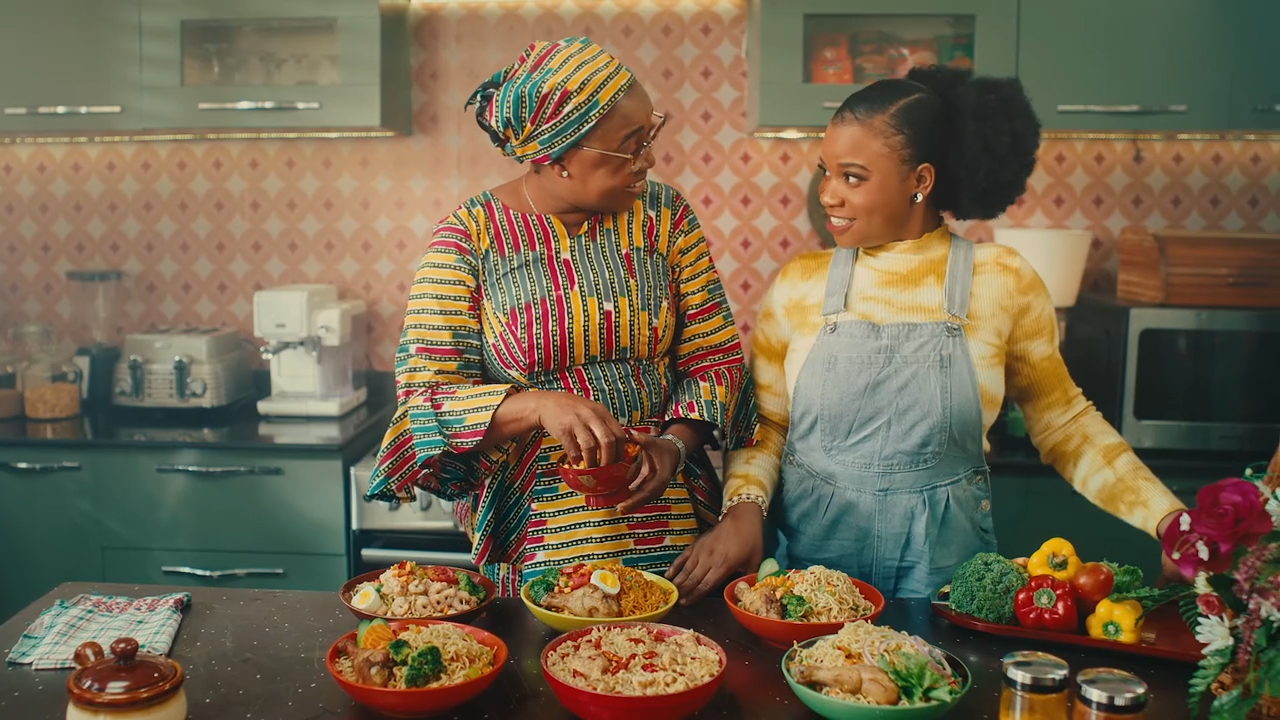
In 2024, the brand brought back “Mama Do Good”, recreating the famous commercial with the same characters, now grown up. What made the campaign interesting was that the audience had grown up too. Instead of simply bringing the jingle back, Indomie tapped into the audience’s memory of the original commercial. The children from the original advert were now adults, and suddenly you were looking at them through completely different eyes.
And MTN has been doing something similar with nostalgia as part of its 25th anniversary campaign. The brand’s “We’ve Come a Long Way” campaign has leaned heavily into its history in Nigeria, which led to them creating the 2026 “Mama Bomboy” commercial. The more interesting thing to me is the connection between MTN’s old “Mama Na Boy” commercial and this new 2026 commercial.
The original commercial introduced us to a mother and son within a Nigerian community. More than two decades later, the newer campaign revisits that world in a different way, this time giving us another perspective on the relationship. It is basically taking a piece of someone’s memory and giving it somewhere new to go. And I think that is where Nigerian commercials get really interesting.
Because the things that made the old jingles work haven’t disappeared. Brands still want us to remember them. They still want us to associate them with a feeling. They still want their campaigns to become part of our conversations. The difference is that they have a lot more tools now. A campaign can have an influencer, a popular artist, an emotional story, a catchy song, a nostalgic reference and a TikTok trend all working together. Almost like some kind of advertising symphony and maybe that is why sound is finding its way back into the conversation. We know what happens when a song gets attached to a memory. You can hear something years later and suddenly you’re eight years old again, sitting on the floor in front of the television. We know music works.
Which brings me back to my mum. She doesn’t need to see the commercial again; she just needs to hear the song and suddenly, she remembers the advert. She remembers the show. She remembers what that period of her life felt like.
Maybe I don’t actually miss the commercials. Maybe I miss the person I was when I watched them. And sometimes, all it takes to remember that person, is a song.
Share your take