Io Capitano Review: What It Takes to Reach Europe by Land and Sea
Two 16-year-old cousins leave Dakar for Europe and discover how quickly a journey they chose can fall out of their control. Our review of Matteo Garrone’s Io Capitano.
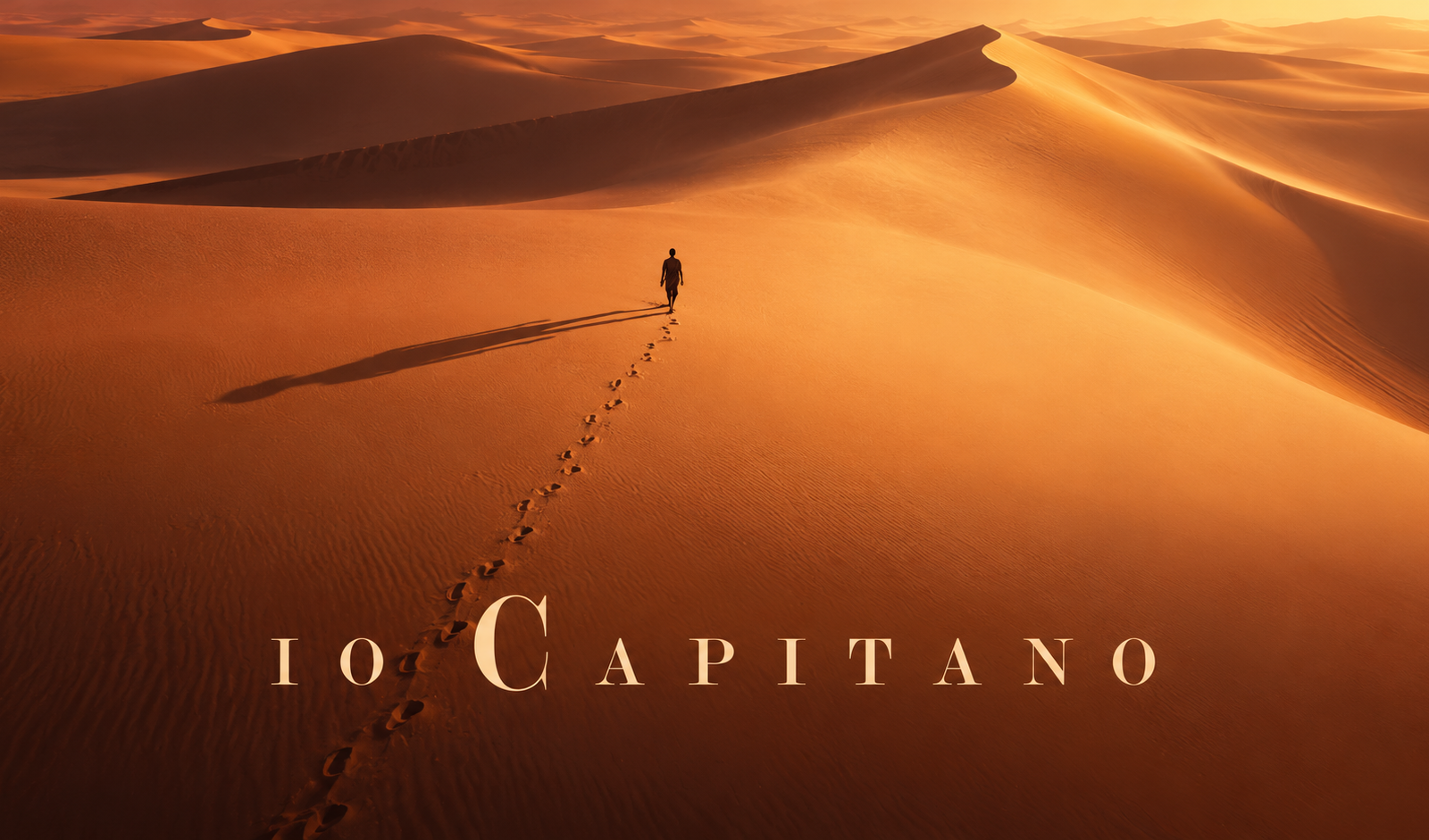
This is an extensive review and contains major plot details.
Seydou and Moussa are 16-year-old cousins living in Dakar who have spent months quietly saving money to leave for Europe. They go to school, take construction jobs when they can, make music together and imagine that, somewhere outside Senegal, that music could become the beginning of a different life.
That is where Io Capitano starts, long before the journey becomes a story about people crossing the Mediterranean. From Dakar, Seydou and Moussa travel through Mali, Niger and Agadez, across the Sahara and into Libya. By the time they reach the sea, they have already dealt with traffickers and corrupt officials, survived the desert and gradually lost control over how the journey unfolds.
The journey is terrifying, but one of the important things the film gets right is that it does not begin by presenting the boys as helpless.
They have friends and families. They go to school. They work. They make music. Seydou lives with his mother and younger siblings, and there is real affection in that home. These are not boys being presented as victims of war or famine. They have lives. They just don’t believe those lives contain enough possibility.
Music is a large part of it. They dream of becoming musicians, making money and being able to do something meaningful for their families. Europe, from where they are standing, feels like the place where that ambition can become real.
Matteo Garrone has spoken about the imbalance behind that dream. A 16-year-old European can travel to Senegal, experience another country and return home. Seydou and Moussa cannot simply decide to travel in the opposite direction. So when people ask why young Africans would put themselves through something as dangerous as the Mediterranean route, Io Capitano does not really answer with an argument. It shows you what that decision begins to cost them.
The journey they imagined quickly becomes something else. First come the fake passports, the checkpoints, the bribes, the traffickers and the men whose business is moving people from one stage of the route to another. Then comes the Sahara, where they are packed onto the back of a speeding pickup truck and driven across a landscape where simply losing your grip and falling off can mean being left alone to die in the scorching desert.
When the vehicles can go no further, they walk.
At one point, a woman can barely continue because the soles of her feet have been destroyed by the journey. Seydou falls behind trying to help her while everyone else keeps moving. There is only so much he can do, and eventually even he has to leave her.
It is one of the first times the film really establishes something about Seydou that becomes more important as the story goes on. He struggles to accept that survival should require him to stop caring about what happens to somebody else.
That instinct keeps showing up.
When armed men separate him from Moussa after discovering money Moussa has hidden inside his rectum, Seydou eventually gets an opportunity to continue towards Europe. He refuses to go without finding his friend.
By this point, Seydou has already been imprisoned, brutally tortured and sold into forced labour alongside Martin, an older migrant and bricklayer. He eventually works his way to Tripoli and manages to find Moussa again, who had been shot in the leg while escaping prison.
They are still determined to reach Europe, but they no longer have enough money to pay for both of them to cross, while Moussa now risks losing his injured leg if he does not receive treatment in time.
That is how Seydou ends up being asked to drive the boat.
He has never sailed one before.
A trafficker gives a 16-year-old boy a hurried explanation of the controls, teaches him how to use a compass and sends him into the Mediterranean with hundreds of people depending on him to get them to Italy alive.
There are children onboard. There is a heavily pregnant woman. People become frightened and agitated. A fight breaks out. Seydou later discovers that some passengers have been locked near the engine because they apparently could not afford the full price of the journey.
He is exhausted, frightened and clearly out of his depth, but the decision he makes is very much in keeping with the boy we have been watching since the desert: he is going to try to get everybody there alive.
That is what I found particularly interesting about Seydou’s arc. The film does not suddenly turn him into a heroic captain in its final act. It keeps putting the same quality in him under greater pressure. First it is a stranger in the desert. Then it is Moussa. Eventually it becomes an entire boat.
The frightening part is how much of this film is real
The journey in Io Capitano is fictional, but it was built from the experiences of people who actually made real life versions of it.
Garrone and his writers worked with the testimonies of Mamadou Kouassi Pli Adama, Arnaud Zohin, Amara Fofana, Brhane Tareke and Siaka Doumbia, who are credited as collaborators on the screenplay.
Kouassi’s story became particularly important to the film. Originally from Côte d’Ivoire, he was 15 when he began travelling north. He crossed the Sahara, was imprisoned and tortured in Libya, was bought and sold by traffickers and spent about three years there before eventually making it to Italy. Parts of Seydou and Moussa’s journey were built from what happened to him and others like him.
The final crossing came from an equally extraordinary real story.
In 2014, Amara Fofana was only 15 when traffickers put him in charge of a boat carrying around 250 people from Libya towards Sicily, despite the fact that he had no experience sailing one. He managed to get them to Italy alive. After arriving, he was arrested on suspicion of being one of the traffickers and spent six months in prison.
Knowing that makes the ending of Io Capitano land very differently.
It also makes the film particularly interesting to watch now because, just this week, Nigerian investigative journalist Fisayo Soyombo published a three-part undercover investigation into the same migration network. Soyombo spent 47 days travelling from Kano through Zinder, Agadez and Dirkou in Niger, then through southern Libya towards Tripoli.
His route is not exactly the same as Seydou and Moussa’s, but the machinery around it is immediately recognisable: the connection men, the repeated payments, the overcrowded vehicles, the corrupt security officers, the migrant houses, the traffickers and the gradual loss of control over where you go next and who you now depend on to get there.
That is one of the things Io Capitano captures particularly well. The boys begin the journey thinking they have made a decision. The further they travel, the fewer decisions they are actually able to make.
A remarkably beautiful film about something ugly
For a film dealing with this much suffering, Io Capitano is remarkably beautiful to look at.
Paolo Carnera’s cinematography is sharp and finely controlled without looking excessively processed. You can see the texture of skin, dust, sweat, fabric and sand. The Sahara is allowed to look enormous when it needs to, but the film also knows when the most important thing in the frame is simply Seydou’s face.
What I particularly liked is that the beauty of the photography rarely feels like the point of a scene.
Garrone said his instruction to Carnera was to make the film beautiful while keeping the photography itself almost invisible. Much of the journey was shot on Steadicam, but used loosely enough that it retains some of the intimacy of handheld photography. As the sea crossing becomes more unstable, the camera becomes less stable too.
The editing works just as well. Scenes are given enough time to register without being stretched unnecessarily. The sound design is equally restrained, and the music does not constantly arrive to explain how you should feel about what you are watching.
Everything works towards keeping you inside the experience rather than reminding you how expertly the experience has been constructed.
The performances are more uneven than the filmmaking, and there are moments where you can tell that some of these are inexperienced actors. Seydou Sarr had never acted before Io Capitano, while Moustapha Fall had some theatre training.
Occasionally, a facial expression or reaction does not land with quite the same precision as the scene around it. But I never found that damaging enough to pull me out of the film. If anything, some of that roughness helps. Seydou and Moussa do not feel too polished for the world they are moving through, and at several points the film comes surprisingly close to feeling like a documentary.
There have been other African films about the trafficking routes into Europe. Òlòtūré, for instance, enters the world of Nigerian women being trafficked towards Europe through Libya. But Io Capitano is the most complete cinematic rendering I have seen of the journey itself, particularly the West African route through the Sahara and Libya before the Mediterranean even enters the picture.
That is what stayed with me most.
By the time Seydou finally sees an Italian helicopter above the boat, Europe is almost beside the point. He has crossed the Sahara, survived torture and forced labour, found Moussa again, learned to steer a boat in minutes and somehow managed to bring hundreds of people across the Mediterranean without losing anyone.
He looks up at the helicopter, completely overwhelmed, and shouts the words that give the film its title:
Io capitano.
I am the captain.
What he means is simple: I brought them here. They are alive.
But we already know something Seydou does not.
The real 15-year-old whose experience helped inspire that part of the film arrived in Italy after doing essentially the same thing and was arrested as a suspected trafficker.
Seydou thinks he is telling the people above him what he managed to do, but they may be hearing something entirely different.
Please share your take if you've watched Io Capitano (2023). If you haven't, no rating needed — it helps keep the ratings honest for everyone.
Leave a review