Is Black Market Selling a Film or a Night Out?
With 50,000 people expected at Tafawa Balewa Square, Black Market is betting that the experience around a film can become part of what audiences are paying for.
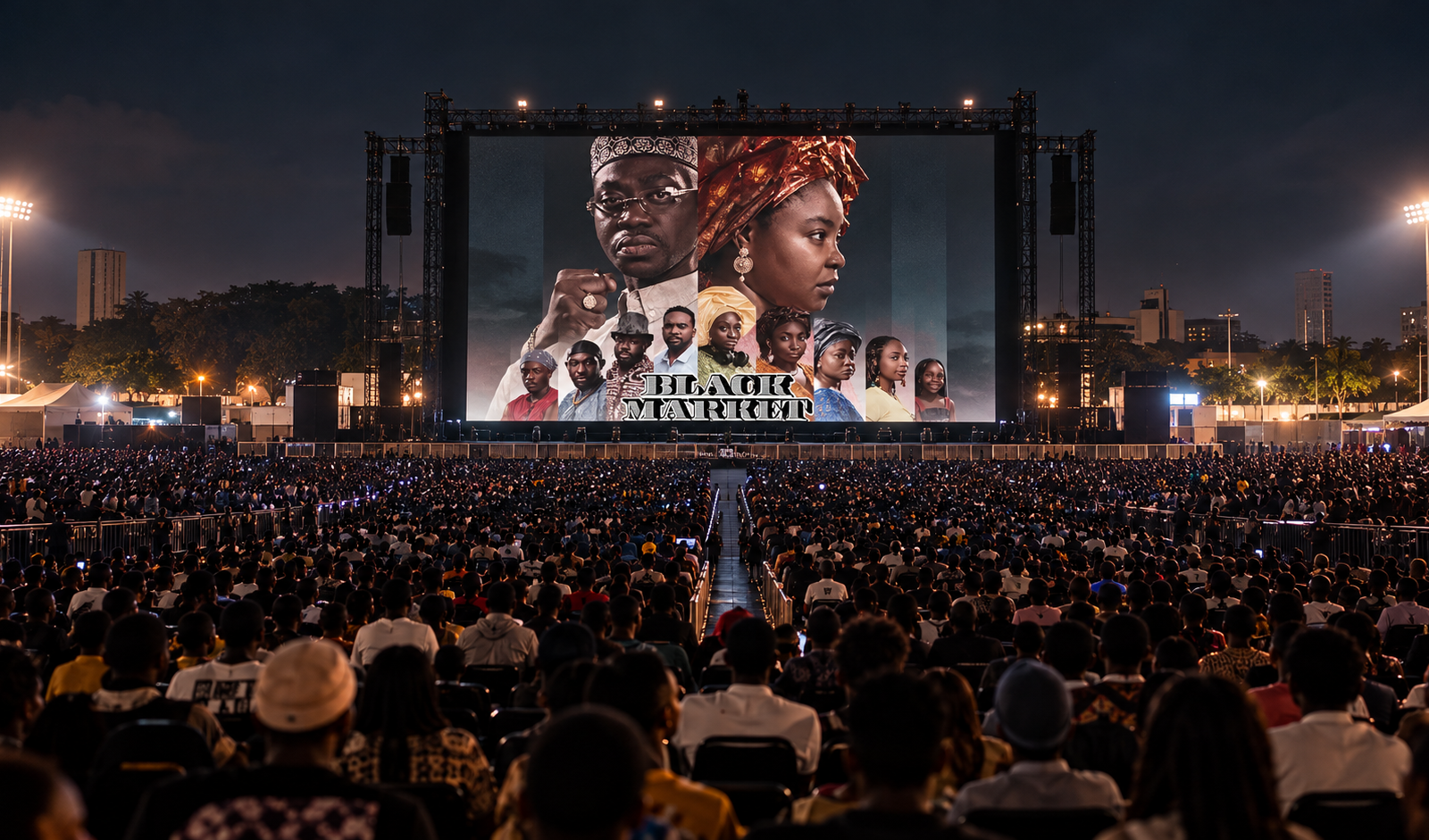
For most of its history, cinema has asked audiences to do one simple thing: leave home, find a screen, and watch a film with other people. However, streaming changed that equation. A growing catalogue of films can now be watched from your couch or bed, on your own time, without the travel, expense, or inconvenience of going to a cinema.
On September 26, Black Market is asking audiences to do the opposite. The Nollywood thriller is scheduled to screen at Tafawa Balewa Square (TBS) in Lagos as part of an attempt to set a Guinness World Record for the largest attendance at a film screening. The producers and organisers are targeting 50,000 people for the screening, aiming to surpass the current record of 43,624 people, set by the 2015 Filipino film Felix Manalo.
While the scale is the obvious story, the more interesting part of Black Market is not simply that 50,000 people might watch a film together. It is that the screening itself has become part of what audiences are being asked to buy.
They are buying a ticket to a film, but also to the crowd, the occasion and the possibility of being present at a record attempt. In other words, Black Market is betting that the movie can be more valuable when the experience of watching it becomes part of the product.
Producer Nora Awolowo told TheCable Lifestyle that the team is working with the Lagos State Government on security, traffic management and transportation, including extended rail services and buses from different stations. Getting 50,000 people to a screening is an exercise in transportation, crowd management, entertainment and marketing as much as exhibition.
A conventional cinema release primarily sells access to a film. Black Market is also selling access to the moment around it. And audiences appear to be responding to that proposition. The official ticketing page now shows all available tickets as sold out.
Cinema-going in Nigeria is becoming more expensive
This experiment comes at a time when going to the cinema is becoming a more expensive outing for audiences. According to FilmOne’s 2025 Nigeria Box Office Yearbook, the Anglophone West African market recorded 2.8 million admissions across 122 cinemas and 369 screens in 2025, a moderate increase from the 2.67 million of 2024, while box-office revenue rose from ₦11.6 billion to ₦15.6 billion.
The figures show box-office revenue growing much faster than attendance, suggesting that pricing and premiumisation are contributing substantially to the gap. That does not tell us that experiential cinema is now the reason people attend. It does, however, show the pressure on theatrical releases to convince audiences that a cinema trip is worth the money: when a ticket costs more, the decision to leave home becomes more deliberate.
That makes Black Market’s proposition particularly interesting. The film is not simply competing with other films for a cinema audience. It is offering an occasion around the film itself.
This idea of making the cinema experience part of the pitch is also visible outside Nigeria. Christopher Nolan’s The Odyssey, released in July 2026, took a very different approach. It became the first feature film shot entirely with IMAX film cameras, including IMAX 70mm, making the format itself a major part of the film’s release. IMAX reported a record-breaking $52 million global opening weekend from its screens, while IMAX 70mm screenings, available at only a limited number of locations, continued to record sellouts weeks in advance.
The appeal is not simply that The Odyssey is a Christopher Nolan film that people want to see in a cinema. Seeing it in IMAX 70mm offers a different proposition from eventually watching the film at home. The size, image quality and physical format become part of the experience.
If audiences can eventually watch a film at home, theatrical releases need to offer something that cannot simply be replicated by pressing play. For The Odyssey, that proposition is the spectacle of seeing Christopher Nolan’s film on an IMAX screen.
For Black Market, the scale comes from 50,000 people watching one Nigerian film at the same time. The event repeatedly frames the record attempt as something audiences themselves will participate in, with those present potentially becoming part of the history the organisers hope to create. That changes the relationship between audience and film.
The two films are selling different versions of the same basic idea: the theatrical experience can offer something beyond access to the film.
You are no longer simply paying for two hours of entertainment. You are paying for the opportunity to say that you were there, you saw The Odyssey in IMAX 70mm, or you watched a movie with 49,999 other people at a screening that could set a new world record.
But can the event sell the film beyond the event?
That is where Black Market faces its more interesting test. A record attempt can generate attention; a crowd can create social media content; a red carpet can attract celebrities and media coverage; and brands can activate around the audience. All of these things can make a premiere feel larger than the film itself.
But the film still has to work.
Director Fatimah Binta Gimsay told TNC Africa that she wants audiences to leave having had a good time with the characters and to want to watch the film again. That is important because the record attempt cannot ultimately be the entire value proposition. If the event creates 50,000 first impressions but the film itself fails to connect, the spectacle has a natural endpoint and could become all the film is remembered for.
If the film does connect, however, the scale of the screening could give it something valuable: a shared cultural moment, word of mouth and momentum beyond the screening.
Streaming can also create cultural moments, word of mouth and longevity. The difference is that Black Market is concentrating that experience physically and temporally. Tens of thousands of people are being invited to encounter the same film together and immediately have an experience to talk about.
The sold-out ticketing page is an early indication that the proposition has generated demand. But the real test comes after September 26: how many people actually turn up, how many stay for the film, what they think of it, and whether the conversation continues after the crowd goes home.
The record, if achieved, will be measurable and historic. The harder question is whether the experience makes people care about the movie.
From release date to occasion
Yes, streaming has made the release date less physically significant. A film can arrive on a platform, sit in a catalogue and wait for an audience to discover it, but the cinema offers a different kind of scarcity. You have to be there at a particular time, in a particular place, with other people, and Black Market is taking that limitation and turning it into its central proposition.
September 26 is not simply the day the film premieres. It is the day the organisers want 50,000 people to gather at TBS, watch the same film simultaneously and potentially become part of a world-record screening.
Whether the attempt succeeds remains to be seen, but the experiment raises a larger question about what a cinema ticket buys you in an age when the film itself can eventually be delivered to your home. As access becomes easier, does the occasion become more valuable?
The future of the cinema experience may therefore depend less on convincing audiences that they cannot watch a film anywhere else and more on giving them a compelling reason to leave home that goes beyond the film itself: a reason to say they were there, experienced it with other people, and were part of something that could not simply be recreated by pressing play.
Share your take