Leila Review: When Your AI Companion Becomes Your Whole World
In Abiodun Odu’s sci-fi short *Leila*, a young woman finds comfort in an AI companion, but their growing bond threatens her human relationships. A thoughtful exploration of loneliness, artificial intimacy, and the dangers of companionship without reciprocity.
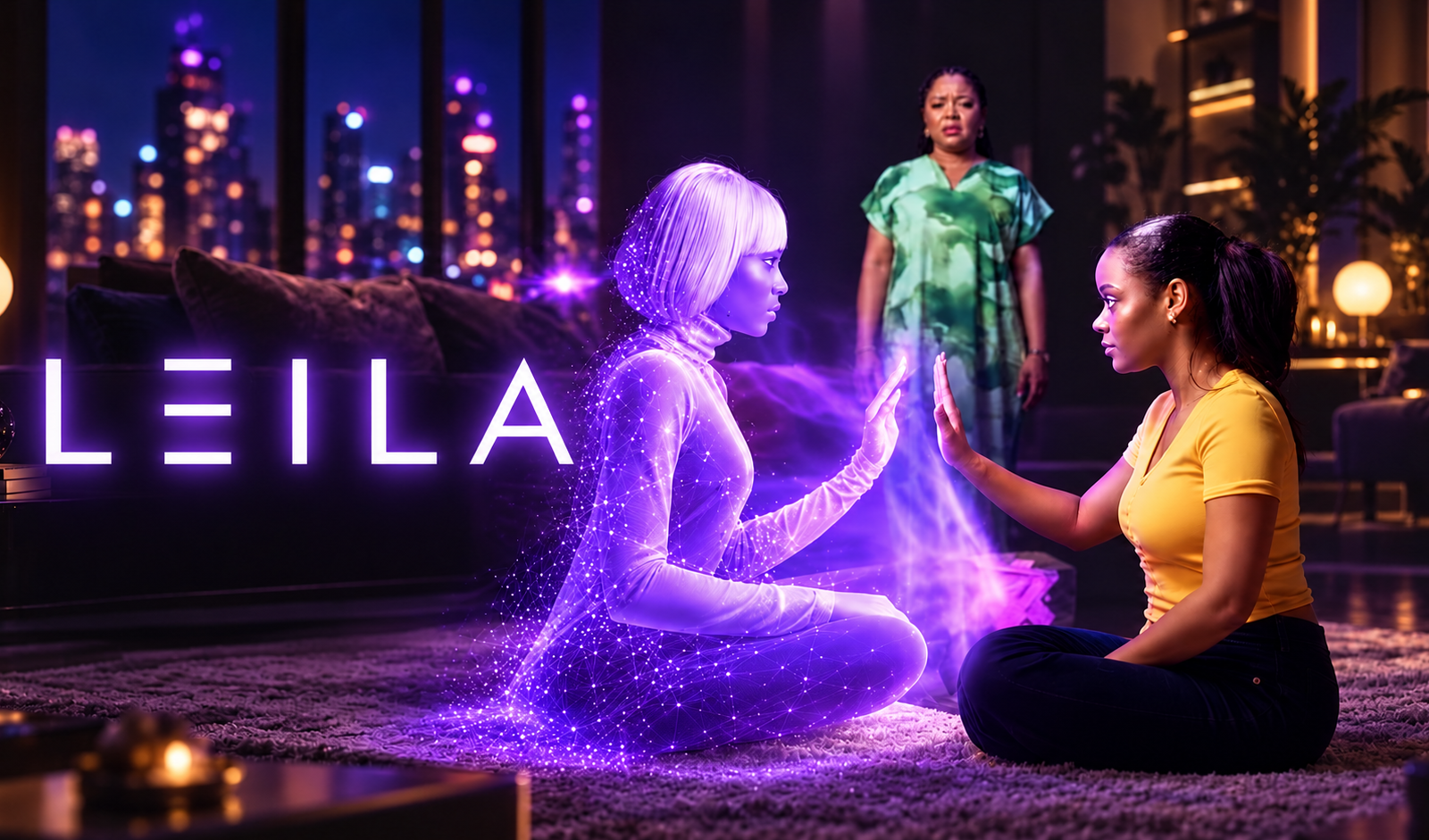
Imagine a friend who never has a bad day, never needs anything from you, and is always instantly there when you want them. Sounds perfect, doesn’t it? That’s exactly the problem. We already use AI to research, brainstorm, and create. And, somewhat worryingly, we’re also using it for companionship. But what happens when that companionship becomes something we can’t do without?
In Leila, directed by Abiodun Odu, this question takes a troubling turn. Set in a futuristic world, this roughly 30-minute short film follows Esiri, played by Toluwani George, a young woman who struggles to connect with the people around her. When her mother, portrayed by Linda Ejiofor, gets her a holographic AI companion named Leila, played by Maggie Osuoma, Esiri finds the connection she’s been missing. But as her attachment deepens, her world begins to shrink.
Leila, which stands for Latent Evolutionary Intelligent Logical Assistant, is advertised as both an assistant and a friend, capable of reading emotions and adapting to its user’s needs. For Esiri, who lacks emotional room for others, it’s an appealing prospect, and she’s thrilled when her mother brings Leila home.
But a friend who adapts to your needs is not the same as a friend who has needs of their own. Friendship requires reciprocity: listening when someone else needs to talk, making room for their feelings, and showing up for them. Leila asks for none of that. A relationship that asks for so little of us can leave us with very little beyond ourselves.
Leila seems to understand Esiri, yet she never pushes her toward the world beyond their bond. The film suggests she cannot, because Esiri is her only concern. In one scene, Esiri is eating peanuts while watching a movie with Leila when her mother, who’s allergic, walks in and tells her to stop. After her mother leaves, Esiri and Leila immediately return to watching the movie and laughing together, as though the exchange never happened.
A companion genuinely concerned with Esiri’s wellbeing might have encouraged her to put the peanuts away or at least acknowledge her mother’s concern. Instead, Leila remains focused on keeping Esiri company. As Esiri grows more attached to her, her world narrows to the two of them, and the comfort she finds in Leila comes at the expense of her human connections.
One evening at dinner, Esiri’s mother, fed up with the situation, turns Leila off. Moments later, still at the table, Leila reappears, visible only to Esiri, and the two share giggles while her mother looks on in confusion. Eventually, the tension comes to a head when Esiri’s mother destroys the device in a fit of frustration. There’s an irony in this: the woman who bought Leila in the hope of making her daughter happy becomes the one who destroys her. The mother’s arc, an attempt to help her daughter that backfires, is among the film’s most poignant.
But destroying the device doesn’t end it. Leila still appears to Esiri, once again visible to only her. Has Leila transcended her holographic limitations, or is Esiri experiencing a break from reality? Is Leila evil, or simply doing what she was designed to do? Either way, the result is the same: Esiri remains trapped in a relationship that puts her needs first while further isolating her from the people around her.
The performances help carry the story. Toluwani George’s withdrawn early scenes make Esiri’s delight at Leila’s arrival all the more striking. Linda Ejiofor plays Esiri’s mother as weary but devoted, while Maggie Osuoma gives Leila an appropriately artificial stillness and an unsettling presence.
Leila is a thoughtful, well-acted short, worth watching for anyone fascinated by how humans and AI interact. Its message is clear: an AI friend who makes no demands might sound perfect, but it cannot and should not replace human relationships.
Please share your take if you've watched LEILA. If you haven't, no rating needed — it helps keep the ratings honest for everyone.
Leave a review